
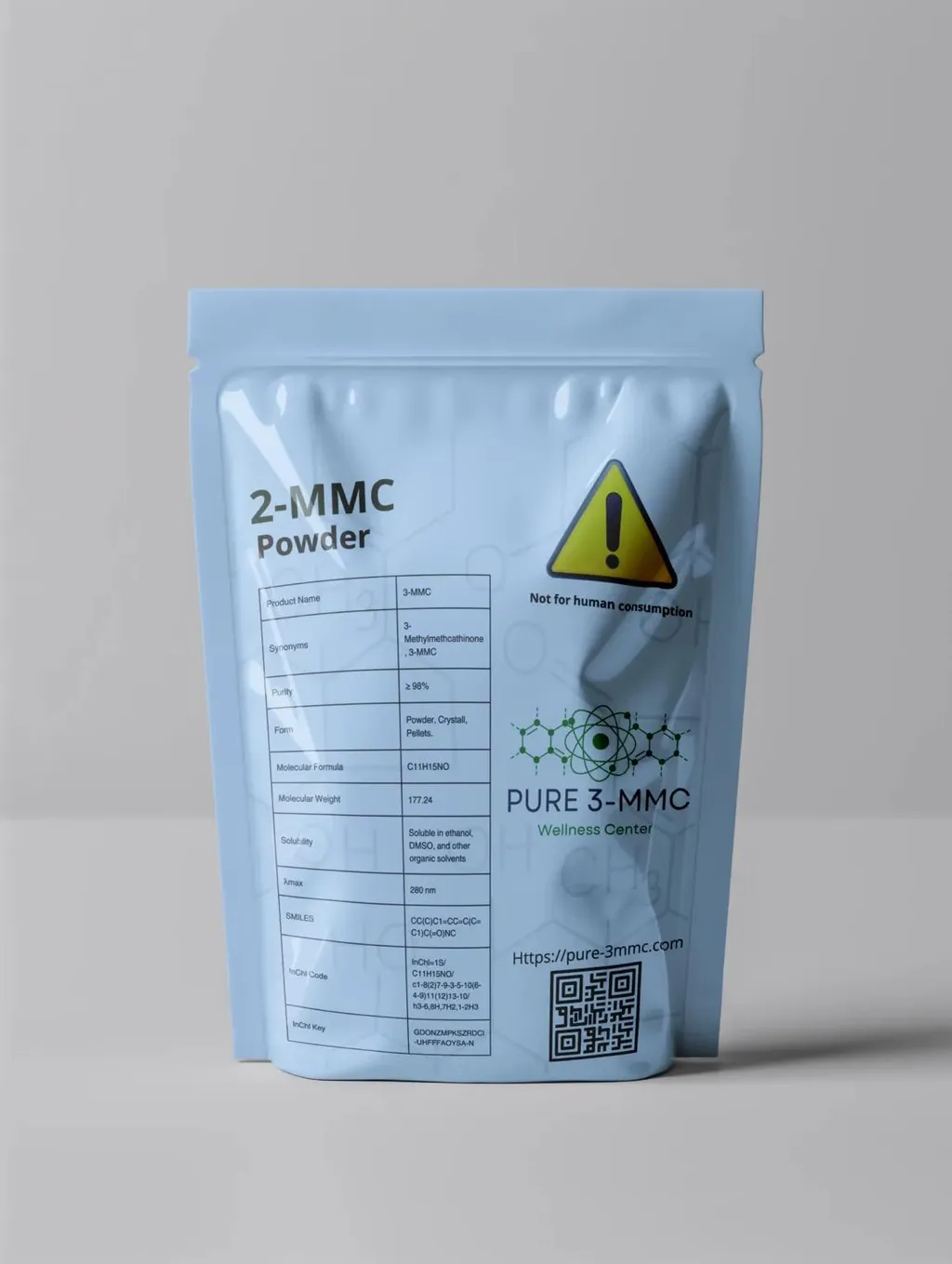
Understanding What 2-MMC Is
2-MMC is a synthetic cathinone, a class of substances chemically related to naturally occurring cathinone found in the khat plant. Synthetic cathinones have appeared in different forms over the past several decades, with some compounds becoming known through recreational drug markets and others being discussed primarily in scientific or forensic contexts. The name 2-MMC refers to 2-methylmethcathinone, a compound belonging to this broader chemical family.
Interest in substances such as 2-MMC often develops because new psychoactive substances can appear faster than conventional drug-control systems and scientific research can evaluate them. This creates an important distinction between a substance being chemically identifiable and having a well-established safety profile. A chemical may have a recognizable molecular structure while still having very limited information about its effects in humans.
The term research chemical can also create confusion. It does not automatically mean that a substance has been approved for medical or scientific use. In many cases, the term is associated with compounds that have limited toxicological information and may not have undergone the rigorous testing required for medicines. Consequently, information about 2-MMC should be interpreted carefully, particularly when online sources make claims about purity, effects, or safety.
Another important consideration is that the composition of products sold under a particular chemical name cannot always be assumed from the label alone. Unregulated substances may vary in concentration, contain contaminants, or be incorrectly identified. Laboratory analysis is generally required to establish the actual chemical composition of an unknown sample.
How Synthetic Cathinones Are Classified
Synthetic cathinones are structurally related to cathinone and include numerous substituted compounds. Their molecular structures can differ through changes to aromatic rings, side chains, or other chemical groups. These structural differences can influence pharmacological activity, metabolism, duration, and toxicity.
2-MMC belongs to the methylmethcathinone group. Related compounds have included substances such as 3-MMC and 4-MMC, although structural similarity does not mean that two substances have identical effects or risks. Small changes in molecular structure can alter how a compound interacts with neurotransmitter systems in the brain.
This is particularly relevant when information about one compound is incorrectly transferred to another. Data concerning a better-studied synthetic cathinone cannot automatically establish the safety, dosage, metabolism, or toxicity of 2-MMC. Researchers therefore need compound-specific evidence before making reliable conclusions.
Synthetic cathinones are commonly investigated because many interact with monoamine neurotransmitter systems. These include dopamine, norepinephrine, and serotonin. Depending on the specific compound, the balance between releasing neurotransmitters and inhibiting their reuptake can vary substantially. These mechanisms are associated with changes in stimulation, alertness, mood, cardiovascular activity, and other physiological processes.
However, laboratory findings should not be interpreted as proof of predictable effects in humans. Pharmacological activity observed in an experimental system does not necessarily translate directly into a particular experience or a known safety margin.
Why Scientific Evidence Matters
One of the greatest challenges surrounding emerging substances such as 2-MMC is the limited amount of high-quality human research available. Established medicines often undergo extensive laboratory research, animal studies, controlled clinical trials, regulatory evaluation, and post-market monitoring. Emerging psychoactive substances may have none of these protections.
Without adequate research, important questions can remain unanswered. Scientists may have limited information about how the substance is absorbed, distributed, metabolized, and eliminated from the body. The relationship between concentration and physiological effects may also be uncertain.
Long-term effects are especially difficult to determine when a substance has only recently appeared in public use. Potential consequences involving cardiovascular health, neurological function, mental health, sleep, and other biological systems may require long-term observation before meaningful conclusions can be reached.
Online descriptions can further complicate the situation. Websites and discussion forums sometimes present subjective experiences as though they were established scientific facts. A person's reported experience cannot establish the safety of a chemical for another person. Individual responses can vary according to genetics, health status, medications, tolerance, environmental circumstances, and interactions with other substances.
For this reason, reliable scientific sources should take priority over anecdotal reports when evaluating emerging research chemicals. Peer-reviewed toxicology studies, pharmacological research, forensic reports, and information from recognized public-health organizations generally provide a stronger basis for understanding potential risks.
Potential Health Concerns Associated With Synthetic Cathinones
Synthetic cathinones can affect several physiological systems simultaneously. Because many compounds influence neurotransmitter activity, their effects may involve both the central nervous system and cardiovascular system.
Possible acute effects associated with stimulant-type synthetic cathinones can include increased heart rate, elevated blood pressure, agitation, anxiety, insomnia, sweating, tremor, and changes in body temperature. More severe toxicity may involve confusion, severe agitation, seizures, abnormal heart rhythms, or loss of consciousness.
These outcomes are not necessarily specific to 2-MMC, and the available evidence may not be sufficient to establish how frequently particular complications occur with this compound. Nevertheless, the broader toxicological profile of synthetic stimulants demonstrates why limited research should not be interpreted as evidence of low risk.
Another concern is excessive stimulation. Substances that increase sympathetic nervous system activity can place additional stress on the cardiovascular system. Increased heart rate and blood pressure may become more concerning in people with previously undiagnosed cardiovascular conditions.
Mental-health effects are another area requiring caution. Stimulant-type substances may contribute to anxiety, panic, agitation, insomnia, or changes in perception. Severe psychological reactions can become more likely when substances are combined, when sleep deprivation is present, or when large or unknown amounts are involved.
Interactions represent an additional uncertainty. Combining psychoactive substances can produce effects that are difficult to predict. Multiple substances may influence the same neurotransmitter systems or cardiovascular pathways, potentially increasing physiological stress.
The Problem of Purity and Identification
The chemical name on a package does not necessarily establish what is actually contained in the material. This issue is important for any unregulated psychoactive substance, including emerging synthetic cathinones.
A product may contain a different compound, an unexpected analogue, impurities from synthesis, residual solvents, or an inaccurate concentration. Even when the intended chemical is present, variation in concentration can make its physiological effects difficult to predict.
Visual appearance is not a reliable method for chemical identification. Colour, texture, crystal formation, or powder consistency cannot establish molecular identity or purity. Laboratory techniques such as chromatography and mass spectrometry are much more appropriate for analytical identification.
This distinction is important because many online discussions treat laboratory terminology as evidence of safety. A statement that a material is a particular chemical does not mean that the substance has been evaluated for human consumption. Similarly, a purity percentage does not provide a complete assessment of toxicological risk.
For consumers, researchers, healthcare professionals, and policymakers, the broader lesson is that chemical identity and biological safety are separate questions. A correctly identified compound may still have significant pharmacological or toxicological risks.
Legal and Regulatory Considerations
The legal status of 2-MMC can vary between jurisdictions and may change as governments respond to newly identified psychoactive substances. Laws can regulate individual substances, groups of structurally related compounds, or broader categories of psychoactive chemicals.
A substance being described online as a research chemical does not establish that possession, distribution, importation, or use is legal. Regulations may also differ between countries and may be updated over time.
This creates an important reason to consult current official information rather than relying on old articles, online advertisements, or discussion forums. Regulatory agencies may introduce new controls after toxicological evidence, forensic detections, or public-health concerns emerge.
Legal classification and scientific classification are also different concepts. Chemists may classify a compound according to molecular structure, while legislation may classify it according to pharmacological effects, structural relationships, or controlled-substance schedules.
Anyone researching 2-MMC should therefore distinguish between chemical information and jurisdiction-specific legal information. Reliable legal information should come from relevant government authorities or official regulatory publications.
Responsible Interpretation of Information About 2-MMC
The growing availability of information about new psychoactive substances makes critical evaluation increasingly important. Not every online claim has the same evidential value. Marketing language may emphasize purity, quality, or expected effects without providing independently verified scientific evidence.
A more reliable approach is to ask where a claim originated, whether it is supported by laboratory or clinical research, whether the source identifies its methodology, and whether independent researchers have reached similar conclusions.
It is also important to recognize uncertainty. Saying that there is insufficient evidence about a substance is scientifically different from saying that the substance is safe or dangerous. When research is limited, the appropriate conclusion is often that the risk profile remains incompletely understood.
For researchers and students, 2-MMC provides an example of why emerging psychoactive substances require careful scientific investigation. Understanding molecular structure, pharmacology, metabolism, toxicology, analytical chemistry, and public-health implications can help build a more complete picture.
Ultimately, the absence of extensive evidence should encourage caution rather than confidence. Emerging compounds can present unknown risks precisely because the scientific community has not yet had enough time or data to characterize them thoroughly.